Skip to content
Sign In Subscribe
 

Yes we tram?

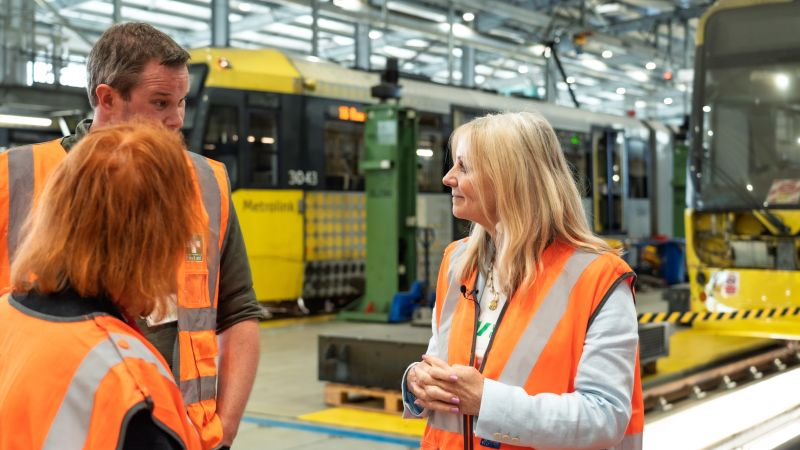
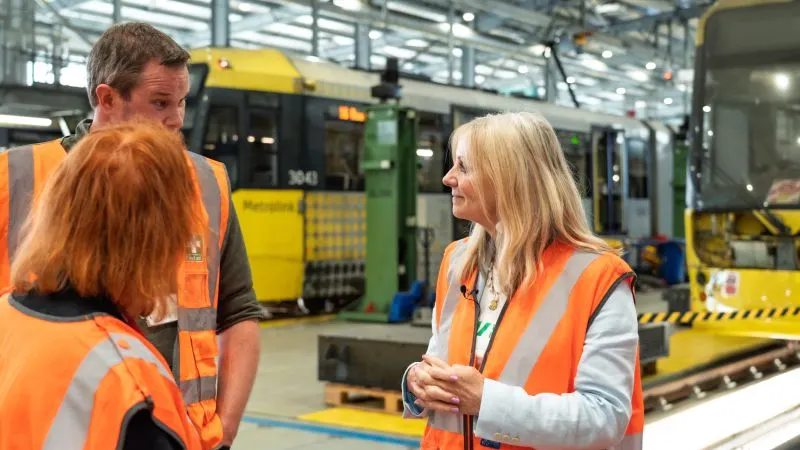
Mayor Tracy Brabin on a visit to see Manchester's MetroLink trams. Image: WYCA via LinkedIn

As the mass transit psychodrama rolls on, the chancellor says one thing, but her civil servants say another

Perhaps it was a bad idea to host an event discussing the city’s frustrated tram dreams in a bar at 6pm, giving attendees little time to line their stomachs before the craft beer started flowing. Perhaps it’s the testosterone-fuelled atmosphere – looking around the flannel-shirted audience, I count 31 men, zero women. Or perhaps the crowd of young professionals here tonight just needed a moment of catharsis, a therapeutic moment to rage against their powerlessness in the face of what they see as a distant and indifferent national government.

Whatever the case, Yes We Tram is about to get heated. 

The event (originally titled “Build the F***ing Tram”) is being hosted by the local branch of Looking for Growth (LFG), a political movement aiming to “break Britain out of stagnation”. Last October, a New Statesman article attempting to locate LFG on the political spectrum deemed them “unconventional libertarians”, also revealing that the gender split here tonight is pretty typical. “The apparent male-dominance of LFG has led some more vicious observers to dub it ‘looking for girlfriend’,” the article notes.

That pronouncement was based on observations of the chapter in London. Tonight’s event — advertised using a psychedelic AI graphic of owls, a Yorkshire rose, and a tram with the destination ‘Ey Up’ — is all about Leeds. Kicking off proceedings is a talk from Edmond Daramy-Williams, the leader of LFG’s Leeds chapter and the unsuccessful Conservative candidate for Armley in the most recent local election. He’s eager to talk us through his vision for the tram. 
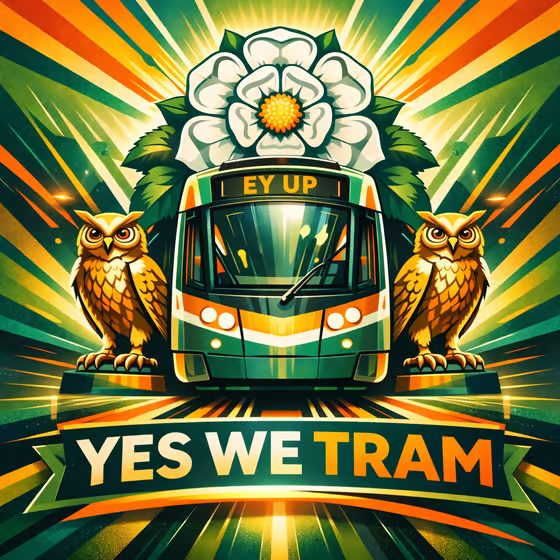
Image: Looking for Growth

It starts simply enough. What Edmond wants to see is “anywhere to anywhere, with maximum one change” – a dream that would require a pretty heroic leap forward from the current dismal state of West Yorkshire’s public transport. But, by the end of his presentation on possible routes and vehicles, he is switching from one idea to the next at an incredible clip. “What if you went for Double Decker Multiple Unit Trams?” he asks the crowd. “Could you run AC trams and DC trains?” Every time I get my phone out to snap a photo of a slide, the presentation has already moved on. I’ve only had a single pint, but my head is spinning.

It’s obvious that Edmond is a member of the generation raised on the internet. Aside from the way his frenetic pace resembles the ever-changing stream of the TikTok algorithm, he’s also fluent in the language of online spaces. When I look at my notes later, I see that I’ve copied down the phrase “Britmaxxed GOAT ukay metro” from one of his slides.

Still, at least he’s talking about practical details. As the event progresses, however, the focus shifts in an angrier direction. Debate over what the tram should look like and where it should go are replaced by another, darker question — one that many people in the city region are now asking.

Who is to blame?

You're reading The Exchange, a brand new in-depth local newspaper covering Leeds and West Yorkshire.

The best way to enjoy The Exchange is to sign up to our mailing list, and you'll never miss an edition. Just click below to join for free.

Sign up for free

“If you say the words ‘Leeds tram’, you’ll be taken out into the car park and shot”

You can understand why resentment is festering. Having transit schemes scotched has become something of a Leeds tradition. In fact, each of the last four decades have seen a new idea come forward, only to be euthanised.

There was the MetroLine (1980s) — killed off in favour of funding Manchester's MetroLink after Leeds council apparently didn't show enough enthusiasm. Then there was Leeds Advanced Transit (1990s) — a futuristic elevated railway, deemed totally impractical and rejected in favour of funding Sheffield's humbler SuperTram plan. Getting the message, Leeds came back with its own “SuperTram” proposal (2000s), a pitch that advanced far enough for preparatory work to start before the government cooled on the idea as costs rose. Finally, cutting its cloak to meet its cloth, austerity-era Leeds wearily put forward a cheap and cheerful “trolleybus” scheme (2010s). This was dismissed as “not in the public interest” by the Department for Transport.

The reasons vary, but the final result is always the same: deeply inadequate public transport. But this time, residents are assured, things are going to be different.

How it might look. Image: West Yorkshire Combined Authority

It’s 20 May, day two of the UK’s Real Estate Investment and Infrastructure Forum (UKREiiF) and the city is thronging with men in open-necked shirts and navy jackets. Down at the docks, there’s a gentle buzz in the West Yorkshire pavilion, as delegates make small talk and browse investment prospectuses. But suddenly, the buzz turns to a bustle. Arriving with retinue in tow is none other than the Chancellor herself, local MP Rachel Reeves.

Reeves poses for photos with Mayor Tracy Brabin in front of a shiny pink map of West Yorkshire, clustered with investment schemes. As they turn away from the cameras, something catches her eye. “Someone pass me a sharpie,” she orders. One is duly found. Turning to the map’s legend, Reeves crosses out the phrase “Proposed Mass Transit Corridor” and writes a single word in its place: TRAM. Reeves throws the sharpie into the cheering crowd, the two women embrace each other with glee, and the Chancellor and her posse roll out of the tent again.

The moment, I’m told, felt spontaneous. But of all the four-letter words the Chancellor could have scribbled on the board, this was the most offensive for many of the civil servants working in transport. The words “mass transit” are the officially accepted term because no-one has yet formally agreed that trams will be involved. “If you say the words ‘Leeds tram’ to [DfT civil servants], you’ll be taken out into the car park and shot,” one informs the crowd at the Yes We Tram event. “No routes have been agreed, and no mode has been agreed.”

This, it transpires, is the key issue. But it took a leaked document to prove it.

A delighted Tracy Brabin, as Rachel Reeves takes to the board. Image: BBC News

The moment that enraged everyone on the pro-tram side came in December. Just a week before Christmas, they received the worst gift imaginable: news that the mass transit programme was being pushed back. The plan to get services running by the mid-2030s was abandoned and the can was kicked down the road for another few years. (A page still live on the West Yorkshire Combined Authority (WYCA) website suggests the authority was at one point even more optimistic, promising the scheme would be up-and-running in the early 2030s.)

This was the moment when, in the minds of many, the Leeds tram left the realm of “projects that will probably happen eventually” and joined the list of doomed pipe dreams. There is a long way to go before the late 2030s and, as those who lived through the HS2 trauma know, this leaves plenty of time for the axe to fall.

As the anger built, one elusive document became the centre of attention: a report put together by NISTA (the National Infrastructure and Service Transformation Authority), which is part of the Treasury. This document was clearly central to the decision to delay. Freedom of information requests started going in all over the shop (only to be turned down). Eventually, the document was leaked to the Parliament’s House Magazine.

As the House magazine reports, NISTA’s central criticism is that the Mayor and her team have jumped to the conclusion that trams are best, without properly testing that assumption. “There is a need to build the case for trams which has not been completed,” the report says, noting a “lack of unbiased thinking” and suggesting the “benefits:cost ratio” would be higher for a bus rapid transit solution. Driving the knife in further, the report cautioned that there was a risk of “political embarrassment[...] if there was a large disconnect between a lauded ‘spades in the ground’ date and the start of actual work”. (I asked WYCA for their response to these criticisms, but they didn’t answer.)

Essentially, as these snippets of the report suggest, WYCA had started planning as if trams were definitely on the table, failing to jump through the proper bureaucratic hoops first. Two months later, the WYCA director who was leading the project, Mike Birch, handed in his notice, having been in the role for less than a year. At the time, he explained on LinkedIn that “the focus has shifted from an accelerated delivery programme, to one following a more traditional sequential approach”.

Image: Mike Birch via LinkedIn

The post he made on the day he actually left the job was even less subtle. Featuring a photo of two cufflinks with “Time for Trams” engraved on them, Birch wrote: “Keep pushing, it’ll soon be Time for Trams!!” (I asked Birch for a comment for this piece — he said he had nothing further to add.)

There are thus, it’s fair to say, pretty mixed messages coming out of the Treasury. The Chancellor, the very woman who runs it, could not be clearer that the plan is to build a Leeds tram (Keir Starmer has also signalled strong support just this week). But, behind the scenes, her own civil servants seem to be digging their heels in.

At its heart, this is a battle between politics and process; between those who think a thing should be delivered because people have voted for it, and those who think there still needs to be clear proof of value for money. Civil servants are being pushed to greenlight an investment of what will ultimately be billions of pounds; the leaked document suggests they want more evidence it will be worth it first.

An economic consultant I speak to, who is familiar with the situation, sums it up succinctly. “One side is saying: ‘Why can’t we just go ahead?’ and the other is saying: ‘Why can’t you just follow this procedure?’”

Tom Forth speaks on the Yes We Tram panel. Image: Daniel Timms/The Exchange

Back at Yes We Tram, Edmond has been asked several probing questions by the audience, which seem to have slightly punctured his enthusiasm. “On reflection, and having received feedback,” he tells the audience, looking crestfallen, “it’s just not that simple a project.” (It’s a sentiment likely shared by those in WYCA.) But Edmond, it turns out, was only the opening act. The fireworks begin when Tom Forth and Andrew Gilligan, by far the two most vocal members of the four-person panel, square up to each other at the Q&A.

Forth is a local tech entrepreneur and perhaps the best known voice calling for the tram. (If you’ve ever pointed out that Leeds is the biggest city in Western Europe without a metro, you are parroting one of his most famous soundbites). In the other corner, Gilligan is a former transport policy advisor to both Boris Johnson and Rishi Sunak. The argument between the two becomes so heated that Edmond and the fourth person on stage — Lawrence Newport, the CEO of Looking for Growth — struggle to get a word in.

There are some points on which the two men can agree. The first is that Leeds is being monumentally let down when it comes to transport; and the second is that WYCA’s plan to run the first tram line to Bradford is a bad idea. Gilligan argues that it’ll still be slower than the train already connecting the two cities. “Would it be better to build a tram just in Leeds?” Forth responds. “Of course it would!” (However, he argues that the region had little choice if it wanted to secure government support.)

Where the two really butt heads is on the question of why this problem has taken so long to solve. Forth’s contention is that Leeds has been repeatedly betrayed: promised trams, only for the government to get cold feet. But Gillingan retorts that, in a country where every city outside London has inadequate transport, most at least have something. Manchester, Nottingham, Sheffield and Birmingham have all managed to get trams on tracks. Is it really plausible that Whitehall has a special vendetta against Leeds? Or might some of the blame actually lie closer to home?

The tricky thing is, they both have a point.

One of the few images showing what Leeds Advanced Transit might have looked like. Image: Clifford Stead via Leeds Civic Trust

Gillingan is no neutral observer. While advising Boris Johnson, he was involved in the decision to give £200m to fund the start of the tram work. He has regrets. “We gave them £200m. After four years, they’ve spent £120m. They still haven’t decided a route.” WYCA, he notes, has already spent a third of what Nottingham did building the entire phase one of their system — and has nothing to show for it. “I’m really worried this is one going to fail like the two before it,” he adds.

(I later approached WYCA in an attempt to fact-check the fairness of this criticism. I asked how much of the £200m has now been spent, but they didn’t answer. I asked how many staff were working full-time on the scheme, but they didn’t answer. They also didn’t clarify when the business case will be submitted, other than “later this year”. 

They did however give me the following statement: “We are working hard to deliver mass transit for West Yorkshire, to grow our region’s economy, unlock growth, housing and better-connected communities. With the backing of the government and the Chancellor, we are working towards submitting the business case later this year. Our Mass Transit proposals will drive connectivity across Leeds Southbank, Elland Road, the city centre and Bradford.”)

But Forth insists that London — and specifically southern snobbery — truly is to blame for Leeds’ repeatedly frustrated ambitions. “I’ll tell you what happens when I go to Whitehall. People say to me: ‘you’re crap. You didn’t go to private school. You're not up to the level.’”

Mayor Tracy Brabin on a visit to see Manchester's MetroLink trams. Image: WYCA via LinkedIn

“It’s not about where Tracy Brabin went to uni,” Gillingan spits back. “It’s that she’s had £200m and four years, and she’s achieved fuck all.” 

The argument rages on (Forth to Gillingan: “You think you know shit? I know shit!”). But the net result is that, despite its best intentions, it’s unclear that Yes We Tram has done much to move the city’s debate forward, other than giving everyone a chance to vent their spleen.

A lack of traction?

Brabin insists that the tram is still going ahead. She’s also promised to have spades in the ground by 2028 — even if only for preparatory works.

At the crunch moment last December, when Brabin was told her scheme was being put back, she had two options. One was to rage against the decision and unite a city in opposition to Whitehall (call it the “Burnham-in-Covid option”). The other was to grit her teeth and play the game: to do what Gillingan and others say she should have done a long time ago, and put together a solid business case to get the Treasury mandarins on-side.

Brabin chose the second path; in reality, the first was always unlikely under a Labour government. When the business case does go in, it will set out exactly why the Mayor believes trams are the best way forward. It remains to be seen if the Treasury buys it.

Thanks for reading. If you want more like this every week, then sign up to our free e-mail list.

Join our list

Comments

Latest

Yes we tram?

Yes we tram?

As the mass transit psychodrama rolls on, the chancellor says one thing, but her civil servants say another

Members Free