
On the 23rd October 2018, a mental health nurse at HMP Winchester sat down at a computer to work out whether a man was likely to kill himself.
The man, Andrew Goldstraw, was being held on remand. Goldstraw had been taken into custody in advance of a court case, and had been in and out of prison before.
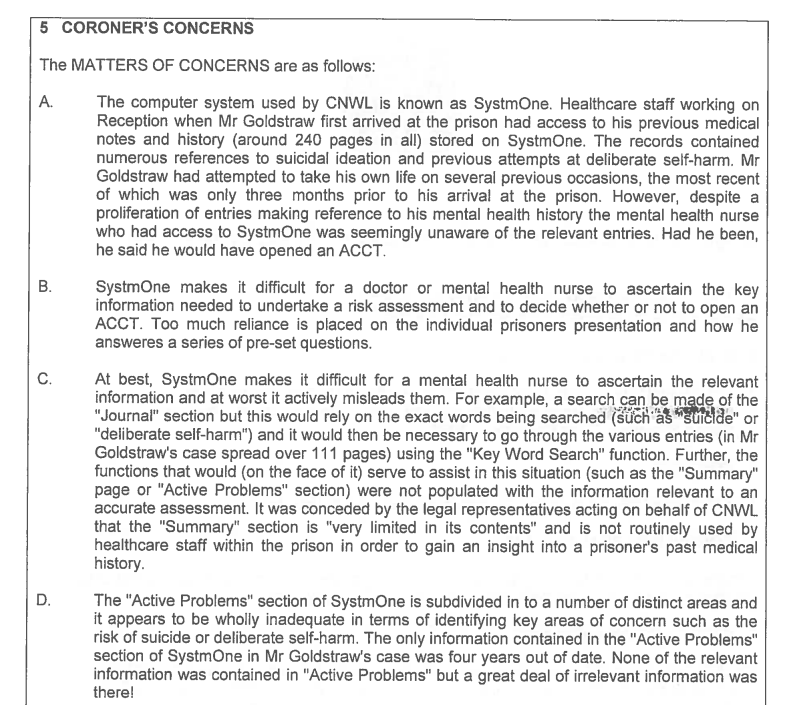
Two hundred and forty pages of medical notes sat in front of the mental health nurse, much of it detailing Goldstraw’s suicidal nature and previous attempts to kill himself. The most recent had happened three months ago.
However, the nurse did not find any of this. They decided Goldstraw was not a risk, and did not place him under observation. Within a month, Goldstraw had killed himself.
Anyone who dies in the care of the state is owed an inquest. But at the inquest, the coroner put most of the blame not on the nurse, but on the software he was using: SystmOne.

Had Frank Hester stayed at seminary as a young man, Leeds’ biggest tech company would never have been born, and Hester would now be tending to his flock. But he dropped out to pursue another path.
Hester had always had a gift for writing software, and, in his telling, saw it as a way to help his family. His mother emigrated from Ireland at sixteen, and helped run the family’s plastering company. Hester learned to code after watching his mother struggle to do the company’s accounts, turning a task that would take her two days of each week into one that took ten minutes. But it was the experience of his father’s death that made the most profound mark on him.
Writing for the Telegraph, he explained that his dad had been clear he didn’t want to be resuscitated. But after a heart attack, doctors failed to identify this wish due to a mix-up in the notes, and brought him back anyway. He was then in a coma for four days before Hester and his mother turned the life support machine off. “This life-changing moment drove me to use the skills I was fortunate enough to have built up as a computer programmer to try and ensure what happened to my father didn’t happen to other people,” Hester wrote.
Two years later, in 1997, Hester founded TPP — The Phoenix Partnership, with a mission to digitise medical health records. For many in Leeds, TPP is most recognisable from the monumentally large sign up over the entrance to the city from the train station. “You’re a 10 minute train journey from a £60k starting salary”, it declares, before adding: “No experience required.”
Hester began by digitising medical records for his local hospital in Keighley. Soon there was more demand. TPP’s flagship product, SystmOne, was principally aimed at GP practices (another family connection — Hester’s wife at the time was a GP) and grew to be the most widely used system nationwide. But the big breakthrough came in 2009, when TPP was awarded its single biggest contract: running healthcare records across every prison in England.

In order for the nurse to have found that Goldstraw had previously attempted suicide, he would have had to navigate through the front pages of Goldstraw’s medical records, find the journal and provide exact words. If the nurse searched “suicide”, “suicidal” would not show. The actual page meant to carry any of Goldstraw’s problems had not been meaningfully updated for four years, with the coroner describing it as “wholly inadequate”. “At best, SystmOne makes it difficult for a mental health nurse to ascertain the relevant information,” the coroner wrote, “and at worst it actively misleads them.”
The coroner also said that “a busy, under pressure mental health nurse or doctor is very likely to struggle to find the relevant entries using SystmOne.”
TPP told us that: “In the case of Andrew Goldstraw who died in 2020, the detailed response from Central and North West London Foundation NHS Trust outlines multiple improvements to local training processes as a result of the Coroner’s report. There was no issue with SystmOne.” However, the Coroner raised eight matters of concern, and all eight related to SystmOne. They were clear that this wasn’t just a training issue.
This wasn’t an isolated case. Eleven months before Goldstraw’s death, John Wright died in HMP Bullingdon, a day after arriving at the prison. The mental health team that had assessed him at court had warned the prison he was at high risk of suicide. But the coroner found that SystmOne would not let healthcare staff add anything to a prisoners’ record until he had been booked in and given a prison number. According to the coroner's report, “[SystmOne] does not enable healthcare staff to make entries prior to the prisoner being received at reception and a prison officer opening a record on the computer and allocating a prison number”.
TPP told us that in the case of John Wright, the Coroner did not include TPP in the Regulation 28 report, a formal document published by coroners used to highlight systemic concerns and to prevent similar fatalities.
In 2023, Daniel Weighman killed himself twelve weeks after being recalled to prison at HMP Chelmsford. According to a Prisons and Probation Ombudsman report, the nurse screening Mr Weighman was unable to access his previous medical records. Had she been able to, he would have been referred into the prison’s mental health team. A PPO report said screening at HMP Chelmsford “was not carried out to an appropriate standard”, with the report highlighting staff’s inability to access health records after recall. The PPO recommended staff gain access to prisoner’s medical records before the initial health screening.
TPP told us that: “the Prisons and Probation Ombudsman recommended that staff should access prisoners’ SystmOne medical records before undertaking their initial health screen. There is no other mention of SystmOne in the report. There was no issue with SystmOne.” However, the report states that this wasn’t possible. “The clinical reviewer reported that the reception nurse did not have access to Mr Weighman’s medical records when she carried it out. We found that the nurse could only access medical records once she had completed the initial health screen, therefore the nurse was unable to refer to the record prior to completing the reception screen”.
This issue has come up elsewhere. Anthony Clacher also died by suicide, just a week after transferring to HMP Guys Marsh. The coroner warned that vital information on SystmOne “could be missed due to the fact the software is more adapted to GP practice than prison healthcare”. She added that “Evidence was given that whilst certain information can be very clear with SystmOne, complex information about emotional difficulties that prisoners may suffer for example is not the easiest to locate and can be missed.”
In Clacher's case, the prison's head of healthcare told the inquest the system “was designed for use in GP practice and not for use in prisons”. TPP denied this to us, saying the coroner “incorrectly concluded that SystmOne may need to be adapted for use in Prisons,” and that “extensive work was undertaken upon commission to ensure that the specific requirements of the detained estate were met by SystmOne”.
In several of these cases, the specific issue seems to have been around transfer between settings and failures with screenings when prisoners arrive in new settings.

By 2019, TPP was thriving. Almost entirely off the back of NHS contracts, the company had become a “unicorn” — valued at $1bn. The Guardian reported that Hester celebrated by throwing a party at his mansion, including real-life horses with strapped on unicorn horns.
Hester, meanwhile, had been on a political journey. Having started out as a Green voter, he became increasingly close to the Conservatives, giving large amounts to the party. He would go on to become its biggest donor.
Hester talked a good game about fixing problems with his systems. In a 2024 tweet, he wrote: “Mistakes are to be expected. So raising the alarm when there’s a potential flaw is critical, and taking ownership of issues is vital to solving them. We’ve seen elsewhere the catastrophic consequences of ignoring the flaws and denying the facts - sobering enough to make me thirsty for that end of week team drink, very shortly!”
This was to be one of Hester’s last tweets. Shortly afterwards, evidence came to light that he had said in a meeting that Diane Abbott “makes you want to hate all black women” and “should be shot”. This led to a police investigation. Ultimately, it was dropped and Hester quietly resigned from the directorship of TPP, with his sister replacing him at the helm.
Hester still owned all the shares. The company’s most recent accounts reveal that the directors (i.e. Hester) had taken £50million out of the business.

However, as the evidence uncovered by The Exchange shows, it wasn’t just “elsewhere” that there were serious question marks over software issues. Mark Jarvis, a prisoner at HMP Warren Hill near Ipswich, died in his cell on 30 December 2015. An inquest found he had a cardiac event brought on by Spice. Two antidepressants that had not been prescribed to him were also in his system.
The prison GP told the inquest that drugs such as antidepressants and opioids had “currency” in the prison. The coroner said that not being able to see what a prisoner had been prescribed was “clearly a cause for concern”.
Nigel Parsley, the Senior Coroner for Suffolk, recorded the GP's evidence that SystmOne left doctors “not being sure what a patient had been previously prescribed, not being sure what repeat prescriptions were in place and that they had no way of readily understanding what had been taken by a particular patient or when they were supposed to have taken it”.
Mr Jarvis’ poor adherence to blood pressure medication which contributed to his death was also blamed on SystmOne, as the prescription system made it hard to track if patients were taking their medication.

In an interview with the Prisons and Probation Ombudsman in 2015, read out four years later during the inquest into Mr Jarvis’s death, Dr Lindsay Crockett, the GP for HMP Warren Hill, said SystmOne prescription module was: “an absolute nightmare and we are banging our heads against a brick wall. We’re trying hard to get some changes done because we are concerned about safety.”
When subsequently asked on the witness stand if the situation had improved four years later, Crockett said no.
TPP told us: “TPP requested further information from the Coroner relating to circumstances surrounding Mr Jarvis’ tragic death as we were confident that the system was working correctly and that it facilitated the provision of safe care for patients if used correctly. Indeed, SystmOne was, and still is, in safe use across the English and Welsh prison estate. Ultimately, no issue was identified with SystmOne.”
Investigative journalism like this takes a huge amount of work. We need your support to continue to do these local investigations. Join today, and get access to all of our stories.
This investigation was supported by the Tenacious Awards.
Do you know more about this story? You can Whatsapp us on the button below, or contact us on Signal, username: theexchange.68. You can also e-mail us at editor@theexchange.news. All information is treated in confidence.